Agent runtime security
Pipelock Open-source agent firewall
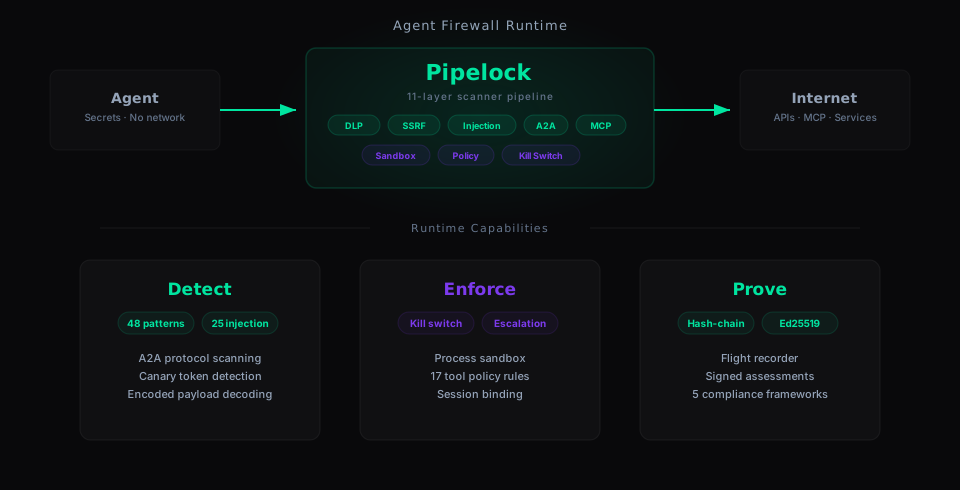
Pipelock scans mediated HTTP, MCP, and WebSocket traffic for secret leaks, prompt injection, and tool poisoning, then emits signed action receipts you can verify offline.
- Core
- Apache 2.0
- Runtime
- Single Go binary
- Traffic
- HTTP · MCP · WebSocket
- Evidence
- Signed decision records
New in v3.7: parallel signed receipts, filesystem grants for containment, cooperative command launch, verified local MCP services, and exact destination grants. Read the release notes and upgrade actions.
The enforcement boundary
The agent keeps the keys. Pipelock guards the crossing.
Pipelock inspects mediated network and tool traffic without storing the agent's credentials. Routing or containment must prevent a direct path around it.
Agent + credentials
The workload owns its secrets and initiates the request.
Web, APIs + tools
Content and destinations are checked before the agent trusts them.
First protected run
Protect one real path.
Install the binary, route one agent through it, then inspect a signed record. The full install guide owns package choices, upgrades, and editor-specific setup.
Install the binary
Use Go here or choose Docker, Homebrew, or a signed release binary in the install guide →
Route Claude Code
Wire one real agent through Pipelock. MCP servers and other agents have their own documented paths.
Verify a receipt
Configure receipt signing for your own traffic, or use the public replay archive to verify one now.
Current containerdocker pull ghcr.io/luckypipewrench/pipelock:3.7.0
Controls at the point of action
Inspect, enforce, and keep the record.
Four control groups replace the feature wall. Open the group you need, or scan the named controls without expanding anything.
Traffic inspection
Check both directions.
DLP and SSRF run on outbound traffic. Response scanning catches prompt injection before untrusted content reaches the agent.
Open traffic controls
Cross-transport DLP. The same engine scans URLs, headers, request bodies, WebSocket frames, and MCP tool arguments. Cross-request detection catches secrets split across requests.
Response scanning. Normalization checks obfuscated prompt injection, control-flow hijacking, and authority assertions before the content reaches the agent.
Media policy. Audio and video are blocked by default. JPEG and PNG metadata is stripped. Browser Shield delivers SVG in sanitized form only after structural validation and refuses it otherwise, and SVG stays refused while Shield is off.
Credential audiences. On inspected traffic, built-in credential classes are allowed at their provider's published API hosts, on the provider's accepted header or path carriers. Other checks still apply, and plain CONNECT without TLS interception relays opaque bytes that aren't scanned. DNS-over-HTTPS is inspected as DNS, and partial disclosure of a known secret is detected.
MCP control
Inspect the tool, call, and chain.
Pipelock scans tool descriptions and arguments, applies tool policy before execution, and tracks changes inside a session.
Open MCP controls
Tool policy. Allow, deny, and redirect rules run before execution. Shell-obfuscation checks resolve variable insertion and backtick substitution before matching.
Session binding. A SHA-256 baseline tracks tool definitions. Mid-session description changes can alert or block.
Tool chains. Subsequence matching finds configured multi-call patterns, while binary integrity verifies the wrapped MCP process before spawn.
Enforcement
Block when the answer is unknown.
Mediated enforcement paths fail closed. Operators can add adaptive policy, a process sandbox, and independent kill-switch sources.
Open enforcement controls
Fail-closed paths. Timeouts, parse errors, oversized bodies, malformed JSON-RPC, and non-terminal human approval prompts block instead of passing.
Adaptive enforcement. Per-session threat scores can escalate policy, then recover as traffic stays clean.
Containment. Linux and macOS process controls can restrict the agent. Deployment isolation must still stop direct traffic from bypassing Pipelock. A contained agent runs in its own network namespace with private /tmp and /var/tmp. pipelock contain run prints a session contract before launch and attempts to write a signed workspace change statement after, and pipelock contain view lets an operator watch the agent's screen.
Evidence and operations
Keep enough context to check later.
Decision records, hash-chained logs, signed assessments, and machine-readable reports keep enforcement evidence attached to the run.
Open evidence controls
Flight recorder. Scanner decisions, policy actions, and session events are hash chained. Optional Ed25519 checkpoints can sign the chain. A process can use parallel receipt chains bound by signed group lifecycle records. Verify the whole group; one valid shard does not prove completeness. A recovery seal attests a discontinuity and preserves the damaged history's failure. HTTP responses carry an X-Pipelock-Receipt header naming the receipt after it is recorded. That needs a configured receipt emitter, and allow coverage depends on flight_recorder.require_receipts.
Assess. Pipelock combines simulation, config scoring, install verification, and discovery into signed HTML and JSON evidence bundles.
CI. The current GitHub Action is pipelab-org/pipelock@v3.7.0. It can scan a diff and fail the job when it finds a blocking issue.
Upgrade. Read the v3.7 upgrade guide before changing receipt automation or containment. Session records. Versioned snapshots capture policy state, tool inventory, verdict summaries, and behavioral fingerprints.
Scanner pipeline
The order is part of the control.
v3.7.0Named checks. Fixed sequence.Read the tagged pipeline
For mediated target URLs, length and parsing happen first. Destination policy and credential checks run before the first DNS lookup; usage limits and a final context check close the path.
- Preflight
Reject a broken target.
Check the request context, length, parse result, canonical host, scheme, destination port, CRLF, and path traversal before policy runs.
- Context + length
- Parse + canonicalize
- Scheme + port
- CRLF + traversal
- Destination
Apply destination policy.
Run the strict allowlist and blocklist, then reject private or metadata IP literals before DNS.
- Allowlist
- Blocklist
- Literal-IP SSRF floor
- Credentials
Stop secrets before lookup.
Normalize the exact SigV4 credential case, then run the immutable and configured DLP floors plus path, query, and subdomain entropy checks.
- SigV4 handling
- Core + configured DLP
- Path + query entropy
- Subdomain entropy
- No network yetDNS starts only after credential checks
- Resolution
Resolve and contain.
Resolve the hostname, then block private ranges, cloud metadata, and DNS rebinding.
- DNS + SSRF
- Decision
Budget and decide.
Apply rate and data budgets, then check the request context again before returning an allow verdict.
- Rate limit
- Data budget
- Final context
- HTTP
- Ordered URL scan plus body and response controls
- WebSocket
- Target URL scan, then frames in both directions
- MCP
- Separate message, tool, policy, and session controls
- A2A
- Separate task, artifact, and agent-metadata controls
Evidence you can inspect
See the decision. Check the signature.
The operator console keeps the scanner verdict, policy action, receipt timeline, and offline verification command together.
 Operator console evidence view
Coordinate more than one agent
One engine. A separate security boundary for every agent.
Community keeps the full scanner and one default profile. Pro adds unlimited named profiles with their own policy, identity, budgets, behavior, and evidence.
Founding price. Flat rate. No per-agent charge. Grandfathered for life.
Policy per agent
Separate DLP, allowlists, rate limits, budgets, enforcement mode, and MCP tool policy.
Identity that holds up
Bind profiles with dedicated listeners, source CIDRs, headers, and trusted domains.
Learn, then lock
Build per-agent behavior baselines, set thresholds, and control sandbox overrides.
Evidence that stays separated
Keep profile-scoped audit trails, receipts, metrics, roster views, and exemption inventory.
Go deeper
Keep going from here.
Compare
Compare Pipelock
See how an agent firewall differs from MCP gateways, WAFs, and guardrails.
Open comparisons →Learn
Understand the threats
Trace MCP attacks and credential leaks to the controls that stop them.
Browse guides →Operate
Install and operate
Get Pipelock running, then verify the proxy and containment before trusting it.
Open install guide →Frequently asked questions
What is Pipelock?
How does Pipelock differ from a WAF or AI firewall for LLM APIs?
What transports does Pipelock scan?
Does Pipelock see the agent's real secrets?
Is Pipelock free?
What does Pipelock catch that a domain allowlist misses?
Does it fail open or closed?
How are rules updated?
pipelock rules install pulls the latest bundle. pipelock rules verify checks signatures against your trusted keyring. Built-in patterns update with each binary release.Can agents reach internal services?
trusted_domains allows controlled exceptions for services with public DNS that resolve to private IPs, such as localhost development servers, local inference endpoints, and internal APIs. SSRF protection stays active for everything else.What's the performance impact?
Get started
Single Go binary (Apache-2.0 core; Enterprise features under ELv2). Install and the proxy is online.