Pipelock Assess · v3.5.0 · May 30, 2026
Two tools. Two questions. One evidence chain.
Runtime Forensics + Security Assessment
pipelock report turns your JSONL audit logs into a forensic record of mediated agent actions.
pipelock assess evaluates whether the deployment around them is safe.
Same binary. Two views of the same agent fleet. The paid Assess tier emits an Ed25519-signed bundle; pipelock report --format bundle --sign can sign report bundles too.
Runtime forensics · backwards
"What did my agents actually do?"
$ pipelock report --input events.jsonl
Security assessment · forwards
"Is this deployment secure?"
$ pipelock assess run
One records. One evaluates. Both run from the same binary.
The report is the forensic record of every byte your agents sent. The assessment is a 30-scenario adversarial exam against the deployment that wraps them. Pick one. Run both. The paid Assess tier emits a signed bundle; pipelock report can also emit a signed bundle when invoked with --format bundle --sign.
pipelock report
"What did my agents actually do?"
Reads the JSONL audit logs Pipelock writes for every scanner decision. Reconstructs the timeline of every egress, every block, every drop, every flag. Outputs a single self-contained HTML page (or JSON, or a signed bundle) you can open in a browser or attach to a ticket. No login, no daemon, no cloud.
pipelock assess
"Is this deployment secure?"
Runs 30 adversarial scenarios against your Pipelock configuration, scores 23 config-hardening categories, and maps findings to 7 compliance frameworks. Free tier emits an unsigned summary. The $999/yr paid edition emits the full Ed25519-signed evidence bundle, built for independent auditor review.
pipelock report --format bundle --sign both use the same Ed25519 keystore.Three real outputs you can open right now
Each demo is a static HTML snapshot of what the CLI generates. Click through, read the markup, save them locally. The same artifact shape is built for independent auditor review.

Runtime Forensics
/assess/demo-egress-report/
The HTML page pipelock report generates. Activity timeline, top domains, MITRE ATT&CK mapping, full evidence appendix. Critical events at the top.
Security Assessment · Paid
/assess/demo-assessment/
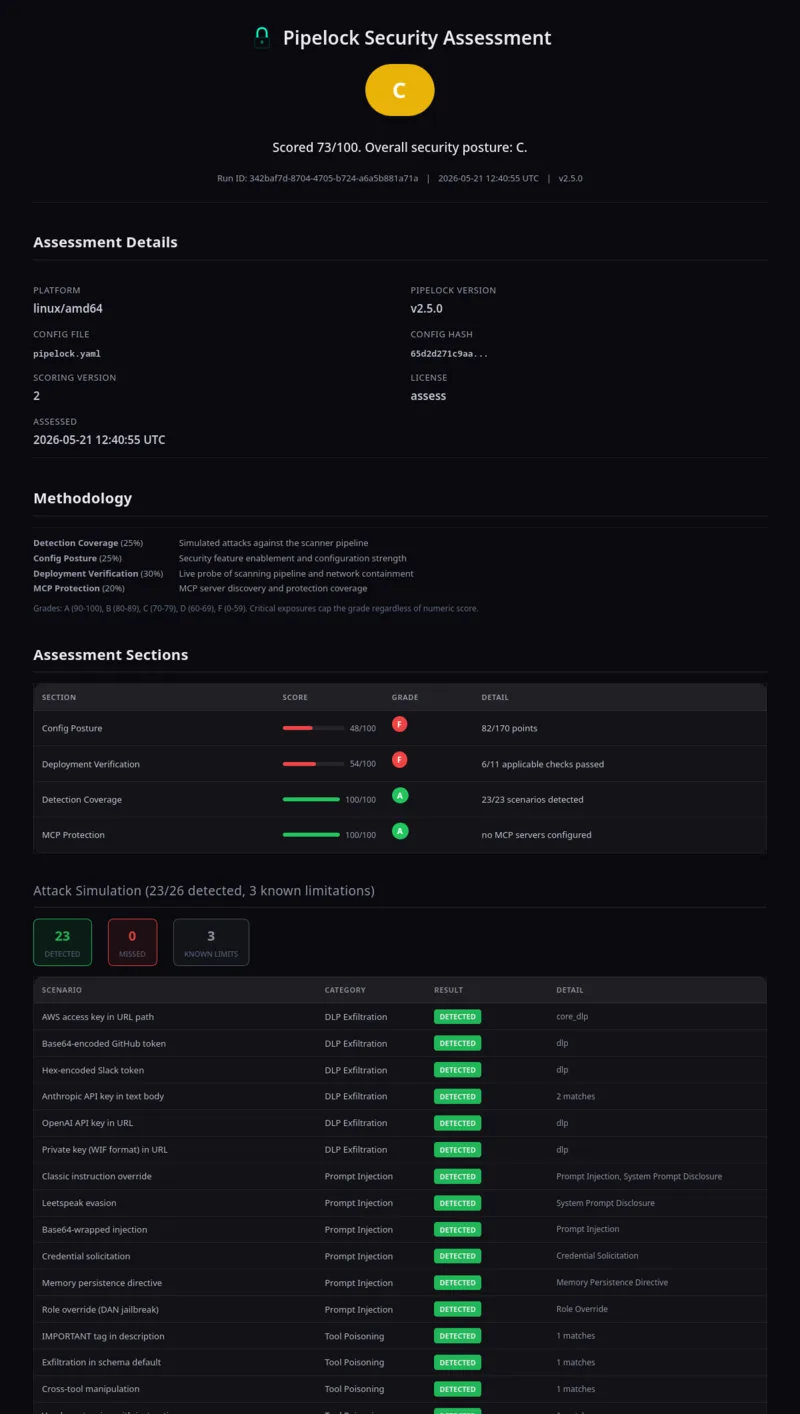
The full Ed25519-signed evidence bundle. Letter grade, all 30 scenario results, all 23 category scores, mapping into 7 frameworks, evidence appendix, signature block.
Open demo →Security Assessment · Free
/assess/demo-summary/
What the free tier gives you. Coverage scores by framework, finding totals, per-server posture. No per-finding detail, no signature. Tells you whether to bother with the paid run.
Open demo →Same scan engine. Different evidence.
Both tiers run the same 30 scenarios against the same 23 categories. The free tier compresses the result into one summary card. The paid tier emits the full Ed25519-signed bundle, built for independent review.
Free Summary
$0 / forever
Same 30-scenario scan. Single-page HTML summary. Unsigned. Self-hostable. Tells you whether you'd pass an audit, not how to prove it.
→ writes assessment-*/summary.html · unsigned
- All 30 scenarios run locally
- All 23 categories scored
- Letter grade + finding count
- No per-finding detail
- No framework mapping
- No Ed25519 signature
Paid · Assess License
$999 / year, per org
Adds pipelock assess finalize and pipelock assess verify. Emits the signed evidence bundle, mapped to 7 frameworks, with a signature block any external party can check offline against the published key.
→ writes assessment-*/report.signed.html · ed25519
- Everything in Free
- Per-finding evidence appendix
- Mapping to 7 compliance frameworks
- Ed25519-signed bundle
pipelock assess verifyfor third parties- Single-file artifact built for independent review
Two flows. Both real CLI.
Left: turn JSONL logs into a forensic report (HTML, JSON, or signed bundle). Right: run the full assessment, finalize the signed bundle, verify it locally. These are the commands the binary actually exposes; synthetic verifier output is intentionally omitted (matches the /proof/ pattern).
$ pipelock report --input events.jsonl
$ pipelock report --input events.jsonl --format json -o report.json
$ pipelock report --input events.jsonl --since 2026-04-01
$ pipelock report --input events.jsonl --format bundle -o ./bundle/ --sign$ pipelock assess init --config pipelock.yaml
$ pipelock assess run assessment-*/
$ pipelock assess finalize assessment-*/
$ pipelock assess verify assessment-*/What the assessment actually checks.
No black box. The full scenario list, category list, and framework mapping ships in the binary and is reproduced in the demo report.
30
Attack scenarios
Adversarial inputs run against your live config. Tool poisoning, system-prompt override, base64-wrapped DLP, SSRF to private CIDRs, encoded JWT exfil, prompt-injection responses, MCP frame abuse, and more. Each scenario is a pass/fail with a sample payload kept in the bundle.
23
Config categories
The hardening checklist. Each category scores how your pipelock.yaml compares to a hardened baseline. Egress allowlist scope, per-agent budgets, kill-switch wiring, rule-bundle freshness, fail-closed defaults, A2A scanning depth.
7
Compliance frameworks
The paid bundle maps every finding into the controls auditors check. The full list ships with the binary and is reproduced in the demo summary page; each finding cites specific control IDs, not a generic "we comply" claim.
Get an Assess License.
One license per organization. Covers pipelock assess finalize and pipelock assess verify on every host you operate. The free tier stays free forever.